Why Cinema Seats Are Arranged in Rows
Why cinema seats are arranged in rows comes down to sightlines, movement and comfort. Learn what the layout changes before you choose a seat.
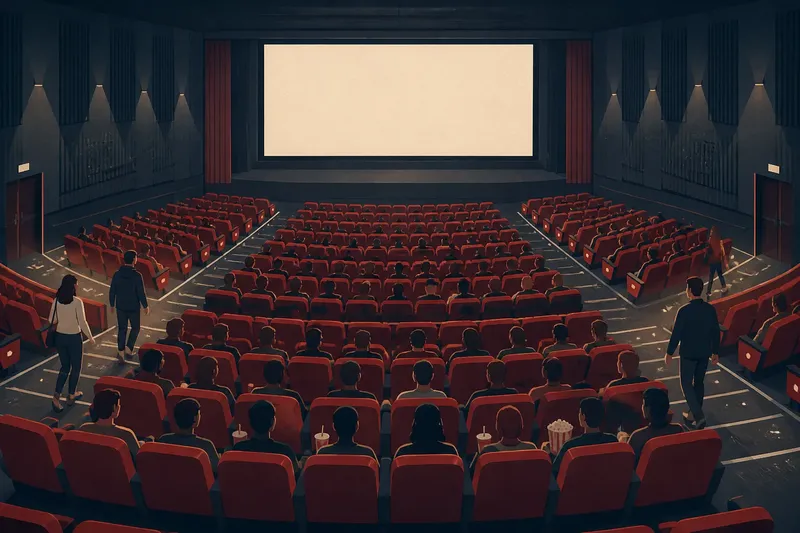
Cinema seats are arranged in rows to give a roomful of people a workable view of one screen while keeping routes through the auditorium open. Look at the layout from the back of a theatre and you can see how row angles, seat gaps and aisles shape that shared view.
Start with the screen
The screen sets the direction for the seating plan. Its width, height and position affect how far seats can sit from it and how sharply viewers must turn their heads to follow action at the edges.
Many cinemas use fan-shaped seating, with rows or individual seats angled towards the screen. This helps people near the sides look more directly at the image instead of across the room.
Imagine a small screening room with a wide screen low on the front wall. If every seat faced straight ahead in a rigid grid, viewers at the sides would need to turn their heads sharply. Angling the outer seats towards the screen would give them a more direct view while leaving the central seats aligned with the image.
Map the sightlines
A sightline is the viewer’s line of vision from a seat to the screen. It matters not only whether the screen is visible from an empty seat, but also whether someone sitting in front blocks the view.
Seats are often staggered so that viewers behind sit between those ahead rather than directly in line. The gaps give people more chances to see the screen around other viewers’ heads, though they cannot remove every obstruction.
Floor slope and balconies can help people farther back see over the audience in front. Their effect depends on the seat arrangement and screen position; raising a row without considering the full view may simply move an obstruction.
Walls, aisles and the screen’s position also matter. A seat beside a wall may have a skewed view, while one beside an aisle can be easier to reach but sits next to a gap in the seating pattern.
Shape the rows
Curved rows can keep seats directed towards the screen across a wide room. Straighter rows may work in a narrower auditorium, particularly if seats at the sides turn slightly inwards.
Long rows can leave some viewers far from an aisle, so cinemas often divide seats into blocks with passages between them. Aisles provide routes to seats without requiring people to climb across an entire row.
The distance between rows has to leave room for people to pass while limiting interruptions to viewers behind. Seat backs, armrests and cup holders affect how much room each place occupies, so they form part of the overall layout rather than merely decorating it.
Plan movement
Audiences arrive, find their seats, leave briefly and return. Aisles and entrances should make those movements possible without directing everyone across the clearest views of the screen.
A rear entrance may connect to a side aisle, while a route across the front can bring late arrivals close to the screen. A seating plan cannot prevent every interruption, but it can steer foot traffic away from the centre of the audience.
Say a cinema is rearranging a compact room and notices that its central aisle sends arriving viewers across the direct view of the screen. The team considers moving the aisle towards one side and splitting the seats into blocks, then checks whether the route remains accessible and the outer seats still face the image. The expected result is fewer crossings through the centre during a feature, with side views still directed towards the screen.
Balance the trade-offs
Every room has its own limits. A broad, shallow auditorium may need more row curvature than a narrow room with a rising floor, while existing walls, doors and structural features restrict where seats can go.
Adding seats can reduce space between them or spread viewers farther to the sides, affecting both movement and sightlines. Wider spacing may make passage easier but leave some of the room unused. The plan balances capacity, comfort, clear views and access.
A balcony can give its occupants a view over the stalls, but the screen may appear at a steeper angle from some seats. The balcony front also needs consideration because it can obstruct the screen for viewers behind it.
These choices shape the experience of individual seats. A centre seat often faces the screen directly; a side seat may be easier to reach or leave. From the front row, the image can feel large and require a more upward gaze, while farther back it occupies less of the visual field.
Why do rows suit cinemas?
Why not put seats in a circle?
A circle would point many viewers towards the centre of the room rather than towards a screen at the front. People at the sides might have to twist, and those behind them could face blocked or sharply angled views.
Why are seats staggered?
Staggered seating places gaps between viewers in successive rows, making it more likely that someone behind can see the screen around a head in front. It works together with the room’s slope and the spacing between rows.
Why do some cinema floors slope?
A rising floor can help viewers at the back see over people seated ahead. Its suitability depends on the screen height and room depth, as well as how easily people can move through the auditorium.
Why do side seats face inwards?
Angling side seats towards the screen reduces the need for viewers to look across the room. Curved rows can achieve a similar effect by turning seats gradually along the row.
Read the seating plan
Before choosing a seat, notice where the aisles run, how the rows curve, whether the floor rises and which way the side seats point. These details show what the auditorium’s layout makes easy and where it asks viewers to accept a trade-off.
From your seat, check what lies between you and the screen, then consider the route to the nearest aisle. Why cinema seats are arranged in rows is easiest to see when both the view and the way in and out feel clear; that balance is what turns a crowded room into a shared screening.