Before the Multiplex: The Neighbourhood Picture House
Neighbourhood picture houses connected filmgoing with familiar streets and local routines; learn how to read their civic role without assuming every town was alike.
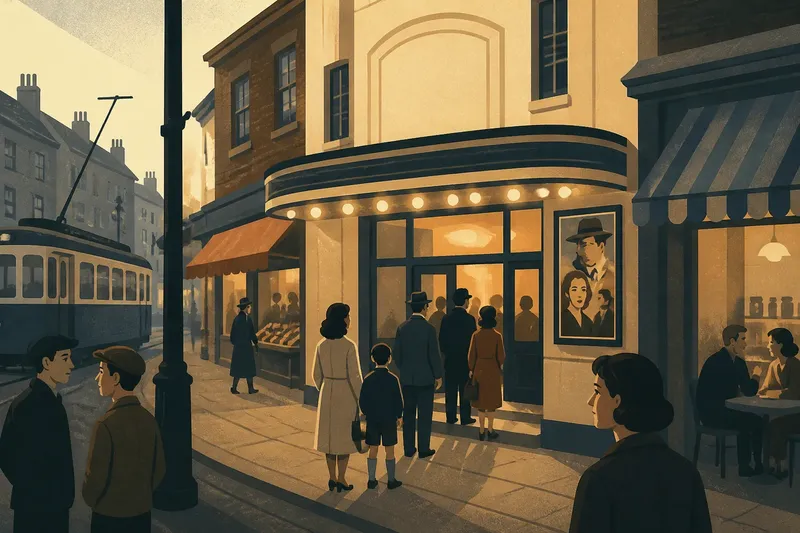
A neighbourhood picture house could make filmgoing part of an ordinary street, but its role varied with local transport, ownership and audience. In some British towns and districts, a cinema near shops or a tram route became a familiar meeting place; that does not mean every cinema served every resident, or that its routines were the same across periods.
A local landmark
A picture house often announced itself through its position and façade. A bright entrance on a shopping street, a sign visible from a tram stop or a prominent corner doorway could make the cinema easy to find. Residents might use it as a point of reference: turn left at the cinema, or wait beside the lit sign.
Its presence connected leisure with ordinary errands. A family might pass the building on the way home from the market, while friends could arrange to meet there after work. How practical that outing felt depended on details such as distance, opening times and transport links.
Nearby cafés, sweet shops and small restaurants could form part of an evening out, though their relationship with the cinema differed from street to street. A walkable location might encourage people to visit more than one business; formal partnerships should not be assumed without local evidence.
Who came together
A local cinema could bring different households into the same public room. Children might attend with relatives, young people with friends, and adults as couples, groups or solo visitors. The audience depended on the place, programme, admission arrangements and social conventions of its period.
Repeated visits could make familiar faces part of the experience. A greeting in the queue might become a conversation the next day, but it is better to describe such encounters as possible routines than as universal habits.
Access was uneven. Cost, transport, opening hours, social conventions and the welcome offered at the door shaped who could attend comfortably. A cinema might matter greatly to one group while remaining inconvenient or unwelcoming to another.
Habits beyond the film
The outing began before the lights dimmed. People chose whom to invite, where to meet and when to arrive. Those arrangements could make a screening a shared plan, whether or not the film was the main reason for going.
Say a shop worker finishes a shift and agrees to meet a neighbour outside a nearby picture house; the neighbour’s cousin walks over from another street. They choose the familiar entrance, attend the same screening and then talk at a café that is open nearby. The expected observable result is a simple local outing organised around a recognisable address, rather than proof that every patron followed this pattern.
Regular patrons might know which entrance was easiest to spot from a bus stop or where a friend preferred to wait. Such practical knowledge made a venue easier to use, but its details belonged to particular people and places.
Small civic rituals
A picture house offered a public setting separate from work and home. A weekly visit, family treat or occasional evening with friends could give leisure a familiar rhythm. The cinema’s programme might become one part of a district’s social calendar alongside school events, market days and local celebrations.
Local identity could gather around the building even for residents who attended only occasionally. Its name might appear in directions or recollections of a street. The strength of that association varied: not everyone nearby would have regarded the cinema as central to local life.
Practical conditions shaped these routines. A late finish could be awkward for someone relying on a bus, while an earlier show might suit a family. To understand a particular venue, look at its routes, nearby shops and opening arrangements, then check local records rather than treating street layout alone as proof of how residents used it.
Reading the street today
Some former picture houses remain cinemas; others have become shops, places of worship, event venues or housing. A changed use is not, by itself, evidence that the building’s past was uniformly grand or that its later use represents a simple loss.
Look for a broad entrance, a façade unlike neighbouring shops, traces of an old sign or a position near historic transport routes. These features are clues, not confirmation. Local directories, planning records, historic photographs and oral histories can help establish what the building was and how people used it.
Ask who attended, what the venue was called and how visitors travelled there. If accounts differ, keep that difference visible: memories can reflect age, class, family custom or familiarity with one part of a district.
Questions about picture houses?
Why did people meet at a local cinema?
A cinema with a recognisable entrance and familiar address could serve as a convenient meeting point. Whether it did so regularly depends on evidence from that neighbourhood and period.
Was the cinema mainly for families?
Audiences could include families, couples, friends and people attending alone. The mix varied by venue, programme, local custom and practical access, so avoid applying one description to every picture house.
How can I identify a former picture house?
Start with the frontage, entrance and any surviving signage, then compare them with historic photographs and local directories. Appearance alone offers clues; records or reliable testimony are needed to establish the building’s use.
What made a cinema a neighbourhood institution?
Visibility, repeated visits and familiar routines could connect a cinema to local life. To assess a specific venue, look for evidence of those practices rather than assuming that everyone in the surrounding area shared the same experience.
What the address held
A neighbourhood picture house had a particular geography: a door on a known street, routes people could manage and a room where separate lives might briefly cross. Its history includes the journey, the queue and the nearby businesses, as well as the programme. When you pass a former cinema, notice its setting and seek local records; together, those details can show why that address mattered to some residents without speaking for them all.